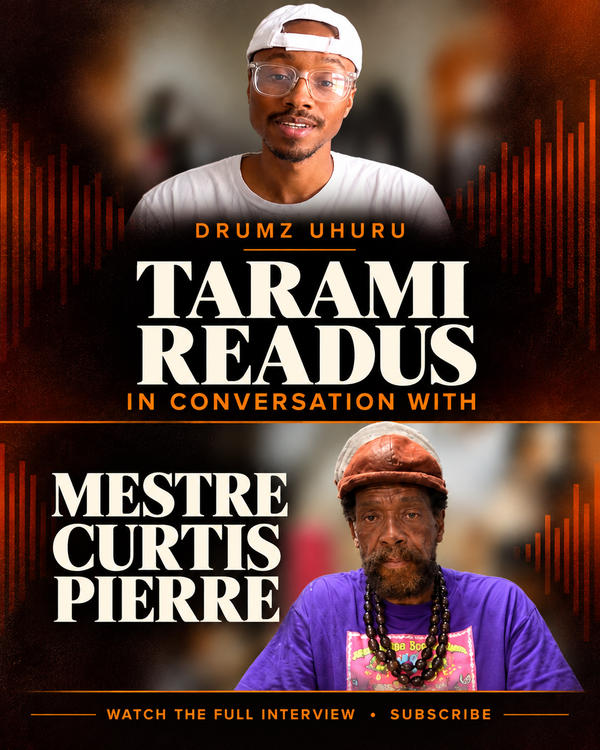
In a new Drumzuhuru conversation, Houston percussionist and cultural worker Tarami Readus sits down with Mestre Curtis Pierre, founder of Casa Samba in New Orleans.
Their exchange explores Afro-Brazilian music, Capoeira, samba-enredo, Carnival, mentorship, and the responsibility of carrying cultural knowledge forward. Pierre’s work has helped build a living bridge between Brazil and New Orleans through decades of teaching, performance, arranging, and community practice.
A Journey Through Rhythm
Pierre’s musical path carried him from Detroit to Los Angeles, where he encountered a vibrant network of percussionists working across African diasporic, Latin, jazz, and Brazilian traditions.
He reflects on advice from legendary drummer Roy Brooks: find the music that moves your soul, then find a serious teacher.
For Pierre, that music was Brazilian percussion. Hearing the sound of bateria through recordings by Airto Moreira opened a path into samba, the berimbau, Capoeira, and deeper study.
In Los Angeles, Pierre also met Munyungo Jackson, the acclaimed percussionist known for his work with Stevie Wonder. The conversation explores how these experiences shaped Pierre’s understanding of musicianship as a disciplined, lifelong practice.
From Salgueiro to Casa Samba
Pierre’s connection to Brazil’s samba world grew through his friendship with Lázaro Franco, a musician he met while working with Brazilian artists in Los Angeles.
Through that relationship, Pierre developed ties with people connected to Acadêmicos do Salgueiro, the legendary Rio de Janeiro samba school. His study expanded beyond percussion to encompass samba-enredo, dance, costume-making, parade design, and the cultural framework surrounding Carnival.
Casa Samba emerged from that work. More than a performance ensemble, it is a New Orleans-based space for studying Afro-Brazilian music, Capoeira, cultural dance, handmade costuming, and Carnival arts.
Brazil and New Orleans
Pierre’s work recognizes a natural relationship between Brazilian Carnival and New Orleans traditions including second lines, Black masking culture, Mardi Gras Indians, brass bands, Social Aid and Pleasure Clubs, and neighborhood parades.
Rather than flattening these traditions together, Casa Samba creates a respectful exchange grounded in study and cultural specificity. That approach was reflected in Mardi Gras Brazil 2025, Casa Samba’s presentation in the Endymion Parade.
Subscribe to Drumzuhuru
The complete conversation offers a deeper look at Mestre Curtis Pierre’s journey, his approach to teaching, his connection to Salgueiro, and his vision for Afro-diasporic cultural work.
Subscribe to Drumzuhuru to read and hear Tarami Readis’ full interview with Mestre Curtis Pierre. Follow future conversations on African diasporic music, culture, tradition, and the artists carrying it forward.