
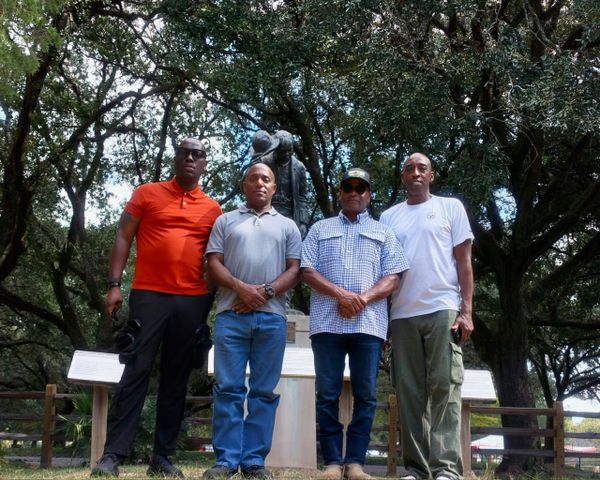
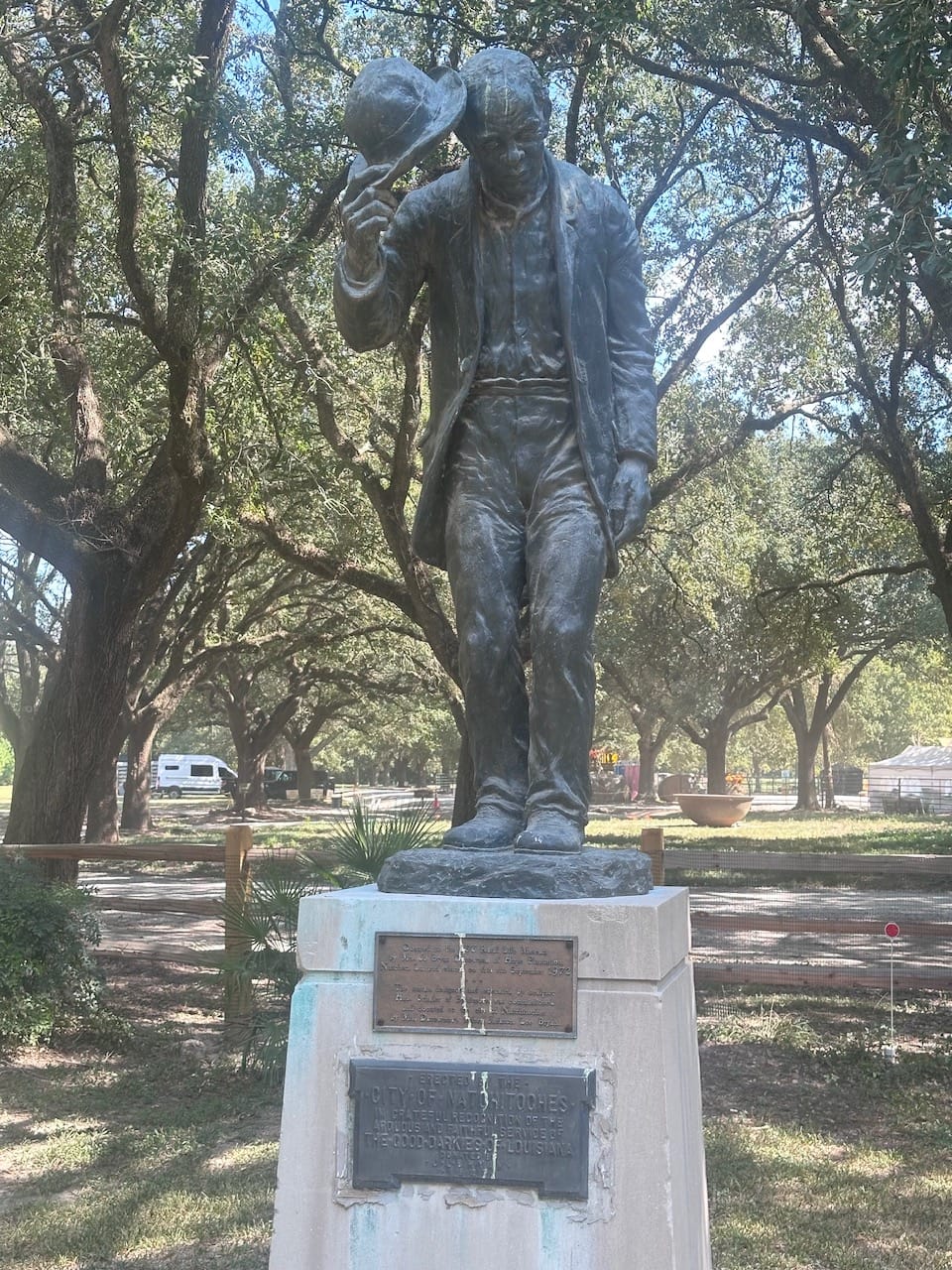
BATON ROUGE, La. — The bronze figure stands beneath the oaks at the LSU Rural Life Museum, one hand raised to tip his hat, the other hanging at his side. On the pedestal, a 1927 plaque reads:
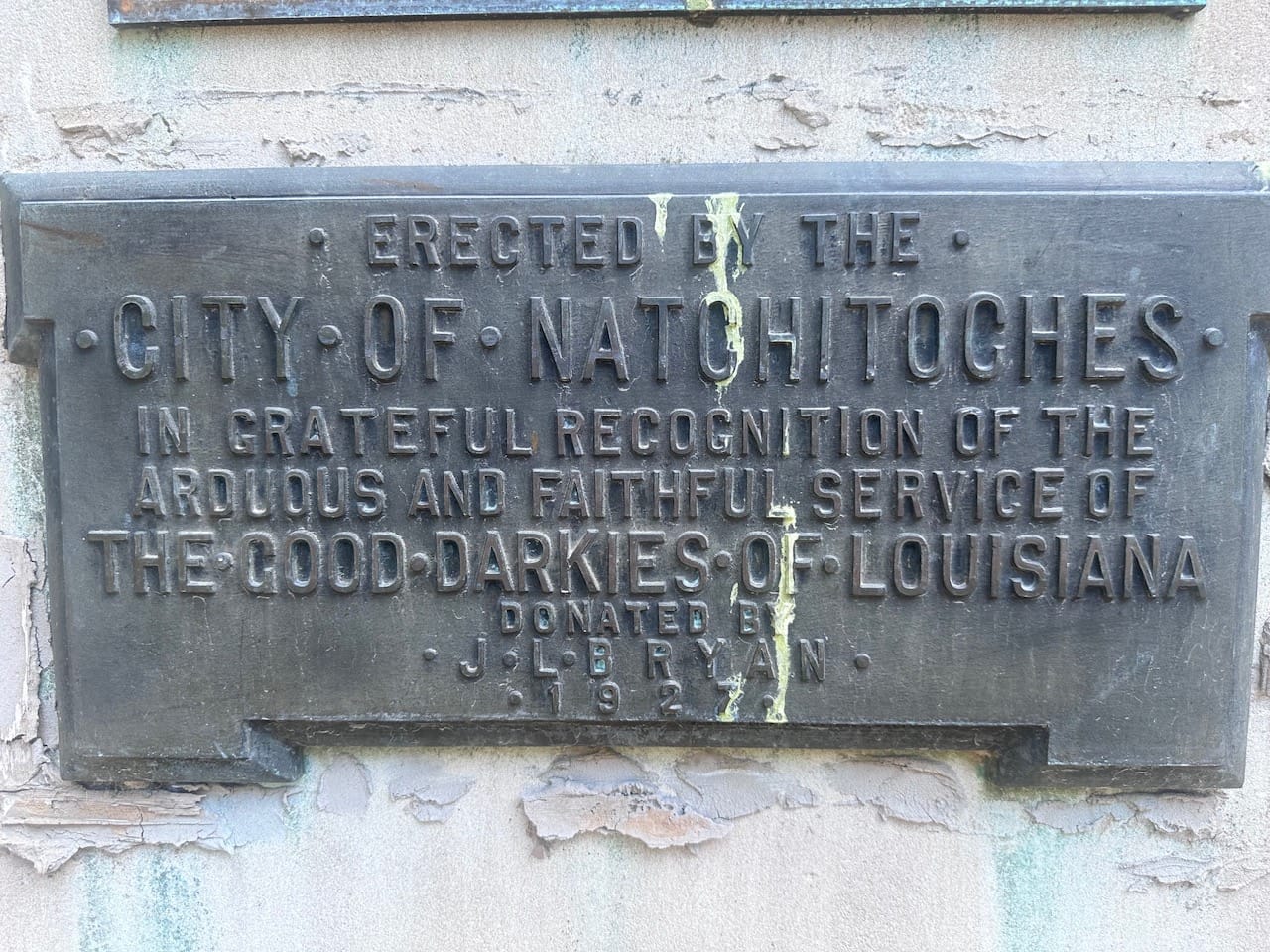
“Erected by the City of Natchitoches in grateful recognition of the arduous and faithful service of THE GOOD DARKIES OF LOUISIANA.”
I stood before it on October 16, 2026, thirty-one years to the day after standing among Black men on the National Mall in Washington, D.C., for the Million Man March.
The distance between those two images was more than geography.
One was cast in bronze, tipping his hat in perpetual deference, his worth described through the service he had given. The other was a gathering of men who had answered a call to take responsibility for themselves, their families, and their communities.
Standing beneath those oaks, I could not separate what the statue represented from what the march had asked of us.
The Praise on the Pedestal
The museum does not conceal the statue’s history. A nearby sign explains that sculptor Hans Schuler of Baltimore left the work untitled. The dedication supplied its first acquired name: “the Good Darky.” It was also called “Uncle Jack.”
The original plaque identifies J.L. Bryan as the donor. A second records that Mrs. Jo Bryan Ducournau of Hope Plantation gave the statue to the museum in 1972.
Today, the museum calls it the Schuler Statue. Its interpretation makes a necessary distinction: objects like this are preserved not to glorify the past, but to examine the role of race in the rural South and the ways that history continues to shape lives.
That distinction matters. Keeping the inscription visible allows us to read not only the words, but the expectations behind them.
What made this man “good” in the eyes of those who erected the monument? The pedestal gives its answer: arduous and faithful service. The bronze figure supplies the posture.
The question is not whether service has dignity. It does. The question is who gets to define a Black man’s worth—and whether the definition leaves room for him to stand on his own terms.
The Men Who Answered
On October 16, 1995, I was in Washington with two of my biological brothers. We had driven from Beaumont, Texas, making the trip in twenty-four hours.
I received a ticket along the way. It did not turn us around.
At four in the morning, we walked from our hotel to the National Mall in the dark and the cold. We found a place and stood from sunup to sundown.
Minister Louis Farrakhan had called for one million Black men to gather for a Holy Day of Atonement. Men closed businesses, took unpaid time, paid their own way, and donated. They came because the call required something of them.
For me, the image we made that day answered the older image preserved in that statue.
We had not gathered to tip our hats for approval. We had gathered to face ourselves.
The call was not a request for permission. It demanded accountability: an honest reckoning with what had been done to us and what we had done to ourselves. Neither truth canceled the other. We could acknowledge the forces that had wounded our communities without surrendering responsibility for what we did next.
“Lazarus, come forth” was the spirit.
Men who had been counted out stood up. Men who had lived with isolation, broken homes, and responsibilities left unfulfilled were called to come out of those conditions—and to stop reproducing them.
The gathering made that hunger visible. The work would have to prove it was real.
Two Images on the Same Day
I have visited the Rural Life Museum many times. On one visit, I was there as an actor in a scene for Underground, filmed on the grounds and later matched in the studio.
A Baton Rouge Film Trail sign nearby lists productions that have used the site, including Underground and Roots. The grounds hold the material history of rural Louisiana alongside the modern stories told against that setting.
But on this visit, it was the anniversary that brought everything into focus.
The statue remained what it was: a product of its time, preserved so its words and posture could be examined rather than erased.
The men on the Mall remained what they were in my memory: men who had answered a clear call and accepted a high standard.
The statue could not define us. But neither could one extraordinary day in Washington finish the work of defining ourselves. That would require what happened after we left the Mall—how we returned home, how we treated our families, how we kept our word, and whether we remained accountable to one another.
Atonement was never meant to be a single day on a calendar.
We Must First Be Brothers
Thirty-one years later, the conditions that made the call necessary have not disappeared. Broken homes, empty pockets, unsafe communities, and men cut off from purpose and responsibility are not matters we can leave inside an anniversary speech.
We cannot honor the gathering while excusing ourselves from the work it required.
If you were there, the work continues.
If you were not there, the call is still open.
Lazarus, come forth.
The spirit of the Million Man March lives wherever Black men refuse to stay in the grave. It lives wherever one man stands with another, keeps his word, and finishes what he started. It lives when brotherhood becomes a duty kept rather than a feeling announced.
Who defines Black manhood?
We cannot leave that answer on a pedestal, in an inscription written about us, or even in the memory of a day when we stood together. We have to answer through the lives we lead and the responsibilities we accept.
We Must First Be Brothers.
Long live the spirit of the Million Man March.
Photography: First photo by Michael Muhammad. All other photos by j19.
Sources
