The World Cup Will Only Matter If Houston’s Communities Feel It
There is a familiar pattern whenever a city gets tied to a global event: bold messaging, big promises, and a flood of civic enthusiasm. The language is often about scale and prestige. Yet those are not the words most residents use when they decide whether something matters. They are more likely to ask whether they were invited in.
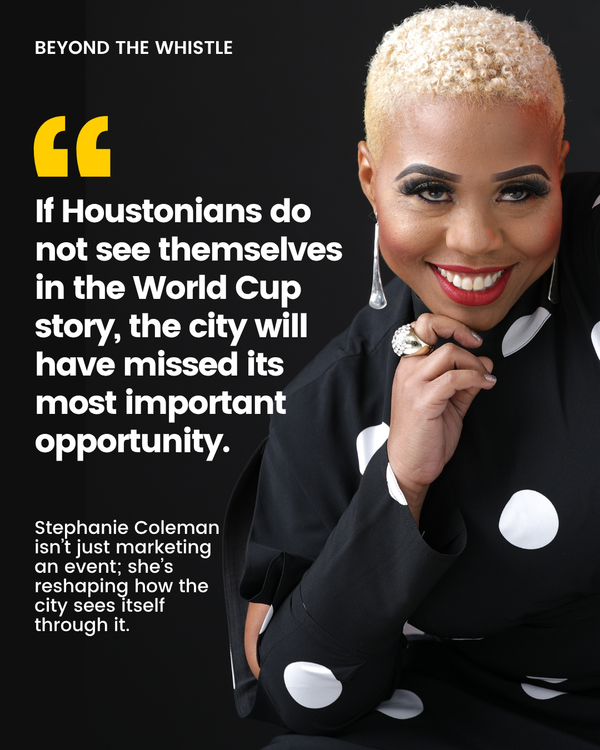
That is why Stephanie Coleman’s apparent focus deserves attention. The central idea is not simply to celebrate the World Cup, but to make it relevant to everyday Houstonians through education, storytelling, and community-centered programming. That may sound modest compared with the grandeur of the tournament itself, but it is exactly the right priority.
The mistake many cities make is assuming that importance trickles down. If an event is large enough, they think, people will naturally care. But relevance is not automatic. It must be translated into local terms. It must meet residents where they are.
For Houston, that means recognizing the city as more than a host backdrop. It is a place of neighborhoods, languages, traditions, schools, churches, businesses, and families with very different relationships to sports, culture, and civic identity. A global event should not flatten that complexity. It should reflect it.
Education is one tool for doing that. Residents need more than promotional excitement; they need context. Why does the World Cup matter? How does Houston connect to it? What opportunities or cultural conversations could it create? Those questions are not secondary. They are foundational.
Storytelling is just as critical. Houston is already full of communities for whom soccer is not a trend but part of daily life and family memory. Telling those stories ensures the World Cup is framed not only through institutions and headlines, but through the people who already carry the sport’s meaning in their own lives.
And then there is programming. This is where intent becomes visible. Community-centered programming says the event is not reserved for insiders or elite spaces. It belongs in neighborhoods, classrooms, public venues, and shared civic life.
- It invites participation rather than passive observation.
- It broadens who feels included in the conversation.
- It helps turn global attention into local connection.
If Houstonians do not see themselves in the World Cup story, the city will have missed its most important opportunity.
That is the deeper promise behind Coleman’s work. She is not just promoting an event. She is helping shape how a city understands itself in relation to that event. The difference matters. One approach is transactional. The other is cultural.
Houston does not need to be told that the World Cup is big. Everyone already knows that. What the city needs is leadership that can answer a more meaningful question: Why should this matter in everyday life? Through education, storytelling, and community-centered programming, Coleman’s approach offers a compelling answer.
If it succeeds, the World Cup will be remembered not only for its scale, but for the way it reached people where they live. That is how global moments become local milestones.