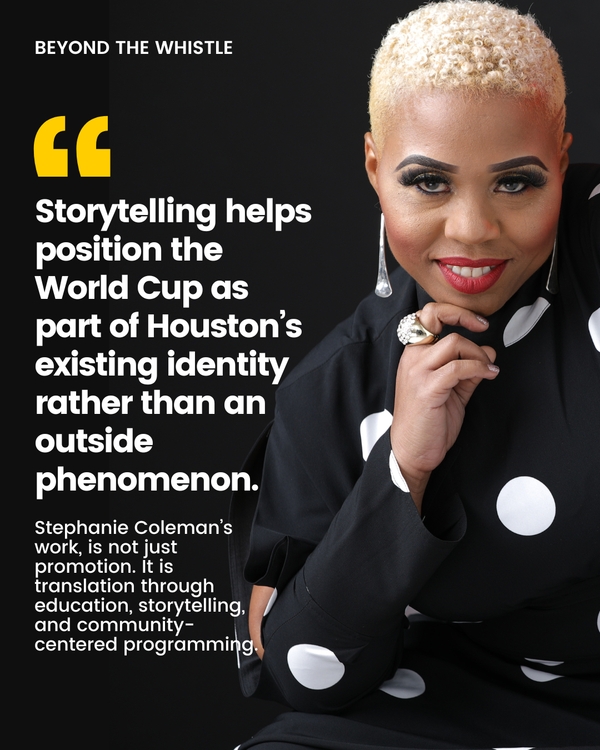
The World Cup is one of the biggest events on the planet. So how do you make something that global feel meaningful in everyday Houston life? The answer, according to the theme behind Stephanie Coleman’s work, is not just promotion. It is translation through education, storytelling, and community-centered programming.
Why is local relevance such a big issue?
Because global scale can make people feel like spectators rather than participants. Residents may hear constant talk about international attention and citywide opportunity, but unless that message becomes tangible, the event can still feel far away from daily life.
What is Stephanie Coleman really doing here?
At its core, her work is about interpretation. She is helping connect a massive international event to the people who live in Houston every day. That means creating ways for residents to understand the significance of the World Cup, see themselves reflected in it, and access it through community experiences.
Why start with education?
Education gives people a foundation. The World Cup may be universally recognized, but not everyone engages with it in the same way. Educational efforts can explain its cultural importance, how Houston fits into the broader story, and why local communities should see it as something more than distant entertainment.
Where does storytelling fit in?
Storytelling makes the event human. Houston is already a city of global connections, and many of its residents have deep ties to soccer through heritage, migration, family traditions, and neighborhood culture. Telling those stories helps position the World Cup as part of Houston’s existing identity rather than an outside phenomenon.
What makes community-centered programming different from standard event marketing?
Marketing talks at people. Community-centered programming invites them in. It creates opportunities for engagement in spaces that feel familiar and accessible, whether through local organizations, public events, educational activities, or cultural programming.
- Education answers: What is this?
- Storytelling answers: Why does it matter to us?
- Programming answers: How can we be part of it?
Why is Houston uniquely suited to this approach?
Few cities are better positioned to connect local life with a global soccer event. Houston’s diversity is one of its defining strengths. That means the World Cup is not just something the city can host; it is something many communities already understand in personal and cultural terms.
The smartest way to prepare for a global event is to make sure local people do not feel left outside of it.
What would success look like?
Success would mean that everyday Houstonians feel ownership of the moment. Not just awareness, but connection. Not just excitement, but understanding. Not just attendance, but participation.
That is why Stephanie Coleman’s work matters. It shifts the focus from spectacle alone to public meaning. In doing so, it points toward a better version of event planning, one where the real achievement is not only attracting the world’s attention, but helping a city’s own residents feel seen within it.