How Stephanie Coleman Is Bringing the World Cup Home to Houston
Global events often arrive with big promises: economic opportunity, civic pride, international attention. But for many residents, those ideas can feel distant unless someone helps translate them into everyday meaning. That is the space Stephanie Coleman appears to be stepping into as Houston prepares to connect with the energy of the World Cup.
The challenge is not just about promotion. It is about relevance. A tournament watched by billions can still feel abstract to a family in Houston trying to understand what it means for their neighborhood, their school, their small business, or their children. Coleman’s work, as framed by this theme, is about narrowing that gap through education, storytelling, and community-centered programming.
That approach matters because major sporting events are often discussed in terms of scale. Cities talk about visitors, infrastructure, brand visibility, and tourism. Residents, however, tend to ask simpler questions: What does this mean for me? Will my community be included? How can we participate? Coleman’s role is meaningful precisely because it starts from those questions instead of skipping over them.
Education is one of the clearest ways to make a global event legible at the local level. When people understand how the World Cup connects to Houston’s identity as an international city, they are more likely to see it as something more than a televised tournament. Educational efforts can help explain the event’s cultural significance, the opportunities it may create, and the ways local institutions can engage before the first match is ever played.
Storytelling adds another layer. Houston is already a city shaped by migration, diversity, and overlapping traditions. Soccer, in that sense, is not an imported storyline but a familiar one. By elevating local voices and experiences, Coleman can help frame the World Cup not as an outside event arriving in Houston, but as a reflection of communities that have long lived here. That storytelling can turn civic excitement into something more grounded and inclusive.
Then there is community-centered programming, which may be the most important bridge of all. Programming rooted in neighborhoods, schools, cultural organizations, and public spaces gives people actual points of entry. Instead of asking residents to simply observe the World Cup, it invites them to participate in it. That distinction changes everything.
A global event becomes local when people can see themselves inside the story.
What makes this vision compelling is that it resists the idea that relevance happens automatically. It does not. It has to be built. It has to be explained. It has to be shared in forms people recognize and trust. Coleman’s apparent mission is to make sure Houston does not just host the excitement surrounding the World Cup, but truly understands and owns its place within it.
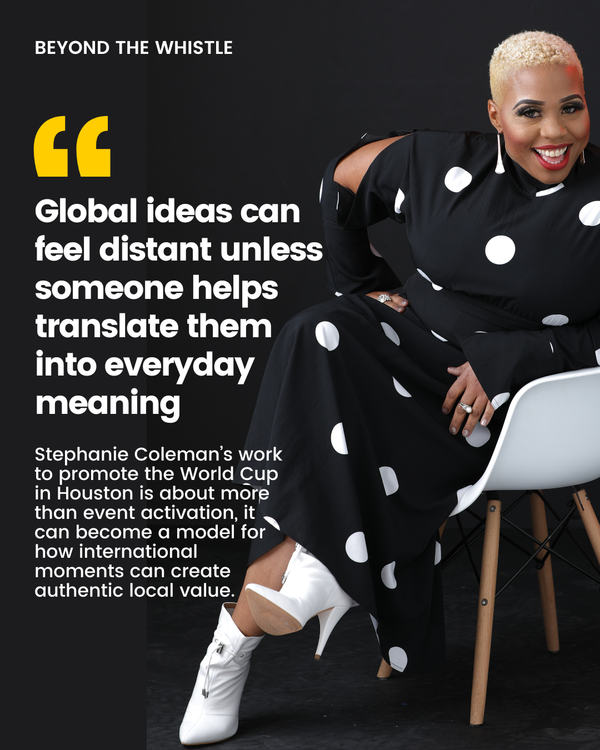
In a city as large and varied as Houston, local impact cannot be measured only by headlines or visitor counts. It must also be measured by whether residents feel invited into the moment. If Stephanie Coleman can help make the World Cup understandable, accessible, and resonant for everyday Houstonians, then her work will amount to more than event activation. It will become a model for how international moments can create authentic local value.