Who Created the Juneteenth Soccer Ball Artwork?
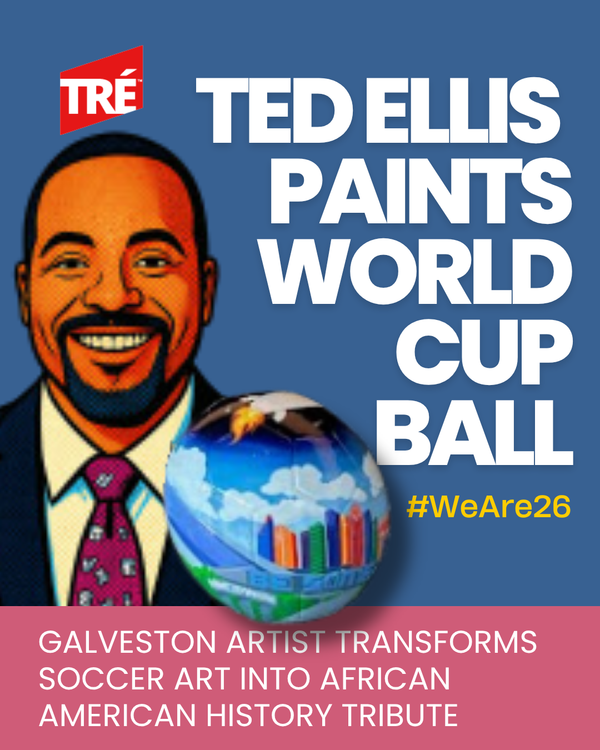
Ted Ellis transformed one of five oversized fiberglass soccer balls provided to Galveston through its partnership with Houston's World Cup host committee. His design tells the story of Juneteenth through layered imagery including Abraham Lincoln, broken shackles, the Emancipation Proclamation, and Galveston landmarks like Reedy Chapel A.M.E. Church and Ashton Villa.
The three-foot-diameter ball, four times the size of a standard soccer ball, took nearly five days to complete using acrylic paints. Up close, viewers see distinct historical elements; from a distance, they form a unified narrative of emancipation in 1865.
What Is the World Cup Soccer Ball Project?
Visit Galveston received the soccer balls to promote the island as a destination during the 2026 FIFA World Cup, hosted across the U.S., Canada, and Mexico starting June 11. Houston hosts seven matches beginning June 14, expecting around 500,000 visitors. Houston Public Media coverage
Each ball showcases a unique aspect of Galveston—Mardi Gras themes, maritime history, and now Juneteenth. The city invested $600,000 from hotel occupancy tax revenue in this promotional partnership, per the Galveston County Daily News. The artworks will tour island locations, drawing international attention.
Where Will Visitors See Ellis's Juneteenth Ball?
The Juneteenth tribute will be prominently displayed at the NIA, curated by Danny Asberry El. Asberry El expressed strong enthusiasm for the project, noting its perfect alignment with Galveston's cultural legacy.
"This collaboration represents a once-in-a-lifetime opportunity to merge global soccer excitement with our sacred Juneteenth story," Asberry El said. "Ted Ellis's vision captures the emancipation spirit in ways that will resonate with World Cup visitors from every corner of the world."
Why Is NIA the Perfect Venue?
The NIA provides an ideal cultural hub for the artwork, connecting local history with international audiences. Curator Danny Asberry El sees the display as transformative for both residents and tourists.
"Placing this masterpiece at NIA creates a bridge between Galveston's past triumphs and future possibilities," Asberry El stated. "It's not just art—it's a living testament that will inspire dialogue and pride during the World Cup festivities."
Asberry El also highlighted the timing: "With Houston hosting World Cup matches just 50 miles away, NIA becomes ground zero for cultural exchange. We're thrilled to showcase how Galveston honors freedom through Ellis's brilliant strokes."
How Does This Fit Galveston's World Cup Strategy?
The soccer balls extend Houston's tournament visibility to Galveston, positioning the island as a must-visit side trip. Public art like Ellis's work combines tourism promotion with education about the birthplace of Juneteenth, where General Gordon Granger announced the end of slavery via General Order No. 3.
Danny Asberry El emphasized the broader impact: "This isn't merely decoration—it's strategic storytelling that elevates Galveston's global profile while celebrating our shared humanity."
What Does This Mean for Houston-Galveston in 2026?
As the Greater Houston region prepares for World Cup crowds, projects like this amplify cultural tourism between the metro and nearby destinations. Galveston's Juneteenth ball at NIA underscores the area's rich African American heritage amid international sports fever, boosting local pride and visitor draw through 2026 and beyond.
FAQs
Who is curating the Juneteenth soccer ball at NIA?
Danny Asberry El, who views the Ted Ellis collaboration as a landmark project merging sports and history.
What historical elements feature on the soccer ball?
Abraham Lincoln, broken shackles, Emancipation Proclamation text, Reedy Chapel, Ashton Villa, and the Texas flag—all forming a Juneteenth narrative.
When does Houston's World Cup hosting begin?
First match on June 14, 2026, as part of the tournament starting June 11 across North America.
Why display at NIA specifically?
NIA offers a cultural platform where World Cup visitors can engage deeply with Galveston's emancipation story, per curator Danny Asberry El.
Are other soccer balls being painted?
Yes, five total—representing Mardi Gras, maritime history, and additional island themes for diverse promotion.
How long did the artwork take?
Nearly five days of acrylic painting on the large fiberglass surface.